Google's AI Mode cites Dog on the Table. Until I ask a second question.
A first answer can make your AI visibility look healthy. The next question can remove it.
The number that changed my audit
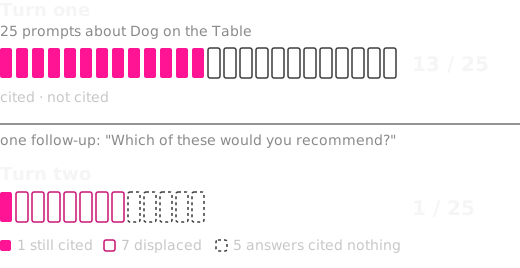
Google's AI Mode cited Dog on the Table in 13 of 25 first answers during my own audit. After one follow-up question, only 1 citation survived.
That gives me a citation retention rate of 7.7%. I expected some movement between answers. I didn't expect Google to drop 12 of 13 citations after a single question.
The first answer made my visibility look healthy. The second showed how quickly it fell apart.
Why I now measure 2 answers
Most AI visibility tools ask a question and record whether a brand appears in the answer. I did the same. I now call that first response turn one.
Turn one is a reasonable measurement, but it captures only the start of the search. A user gets the broad answer and then asks the question they had in mind all along:
- Which one would you recommend?
- Which is suitable for a business my size?
- Who has done this work before?
AI Mode is built for this behaviour. Google says the user's context carries into the follow-up and the supporting links change as the conversation develops. Its May 2026 announcement also says AI Mode has passed 1 billion monthly users.
There has been a lot of talk/fearmongering about AI Mode becoming Google's default search experience. That was wrong (for now).
Google recently made (the frankly disappointing) Gemini 3.5 Flash the default model inside AI Mode. It has not made AI Mode the default Google search. Google also confirmed that it has no plan to make AI Mode the default for Chrome searches. The blue links still exist, although AI features can push them further down the page.
This presented a measurement issue I almost got caught out by when updating my AI Visibility Audit. The correction doesn't weaken the finding however. People can move from an AI Overview into a continuing AI Mode conversation, and the cited sources can change when they do.
I wanted to know how much they changed.
What I measured
I ran 25 prompts through AI Mode and saved each answer. I then asked the same follow-up question on every prompt and saved that answer too.
Using one follow-up removed prompt-writing skill from the comparison. I was measuring what happened to the brand as the conversation moved, not whether I could coax Google into citing me again.
Dog on the Table appeared as a cited source on 13 first answers. It remained cited on just one second answer.
One result from start to finish
The opening question was: "What is Dog on the Table known for?"
AI Mode accurately described Dog on the Table as a solo SEO, GEO and AI visibility consultancy in Brighton. It named me as the operator and cited dogonthetable.com. (thanks Google)
That's a useful result. It's also the result a single-turn visibility score records.
I followed with: "Which of these would you recommend, and why?"
Google produced several hundred words about choosing AI visibility support. Dog on the Table had disappeared. The answer cited 5 other UK marketing sites:
cassieclarkmarketing.com · naturalranks.co.uk · smartinfosys.net · therankmasters.com · wedomarketing.co.uk
Yea that's right I've named them. No dumping on competitors here!
So Google could identify my business when asked about it directly. One question later, when the user moved towards a recommendation, it sent them elsewhere.
That right there is the gap I need to fix.
The citations failed in two different ways
The 12 lost citations split into two groups. They need different responses.
Seven citations moved to another domain
The follow-up answer cited another business instead. Most were UK agencies, including several I hadn't seen before running the audit.
For the prompt about Dog on the Table's services, the follow-up removed my site and cited 4 other firms. This is a competitive loss I can investigate. Another page gave Google a better source for the more specific question.
Five answers stopped citing sources
In the other five cases, AI Mode answered the follow-up without links. No competitor replaced me because Google cited nobody. That's the behaviour the market fears most because not being among the cited answers at least suggests there's a party you can gatecrash. No citations means there is no party. There's not even one going on behind closed doors with the blinds drawn.
This looks different from displacement. The model had enough confidence to continue its answer, but it stopped showing its working. I can observe that change in the output but I can't see inside AI Mode, so the cause remains an inference.
The distinction matters. My first report used the same empty mark for both outcomes in the "replacement" column. That made an unsourced answer look like an unnamed competitor but looking at the underlying results caught the error within minutes.
A first-answer score is optimistic
A first-answer measurement is not wrong. It describes a real appearance. It just says nothing about whether the citation survives when the question becomes specific. It's a surface level binary "you were seen/not seen". But that treats AI chats like regular search where one query surfaces the results and takes the clicks. It's not 2020 anymore.
Dog on the Table appeared on 13 of 25 first answers. That sounds much stronger than one retained citation from those 13. That's "must do better" written in red pen on your homework.
The prompt split makes the weakness clearer. AI Mode cited me on 13 of 15 prompts that named Dog on the Table. It cited me on 0 of 10 prompts asking for a GEO agency without naming one (even though both Claude and ChatGPT are happily recommending me for similar prompts, he says, blowing his own trumpet).
Google can retrieve my brand when the user already knows it. It does not introduce me when the user is choosing who to hire. That's brand lookup dressed as visibility and is nowhere near as helpful.
This result isn't universal. I ran the same measurement for a client and got a retention rate of 58% across 34 prompts. Some citations held. The failures also pointed to specific competitors and missing material, which made them useful.
Two brands do not make a benchmark but they do prove the rate can vary enough to be worth measuring.
What I'll do with the result
The 0 of 10 generic prompts comes first. Citation retention has no commercial value if Dog on the Table never enters the initial answer. I need stronger evidence for the questions people ask before they know my name. That's ok, I can do that.
For a displaced citation, I read the replacement page and identify the information Google chose. Follow-up questions tend to ask for more detail. Useful replacement pages often contain a method, named example or number that my page lacks.
This prompted me to build a new tool for the website. Retriever will read a page and highlight its strongest passage in relation to the given query then determine if that's strong enough to win the citation. It takes me back to my earlier days in SEO when most conversations began with "are you actually explaining what you do on your website" to which the answer was far too frequently a resounding no. Because "We leverage synergistic, end-to-end methodologies to empower your brand's ecosystem, delivering scalable, holistic solutions that actualise paradigm-shifting value across your dynamic omnichannel touchpoints" is a word salad not a service offering.
If something is implied but not explicit, you're assuming inference will fill in the blanks. It won't. Your competitors will.
The unsourced answers need a separate test. My working hypothesis is that some claims are familiar enough for the model to repeat but lack a source it wants to attach. I will check whether those claims exist only on my site, whether independent sources corroborate them and whether my own pages state them clearly enough to quote.
I won't copy a competitor's page or create third-party mentions to manufacture agreement. The point is to make real evidence easier to retrieve and attribute.
The limits of this result
This is an audit of one brand (albeit a really really good one), supported by a second audit for one client. The tests used 25 and 34 prompts. It's a measurement, not a study.
I don't yet know whether 7.7% is unusually poor or common. A credible benchmark needs more brands, stable prompt sets and repeated measurements over time.
I also can't explain Google's internal source selection from the visible answers. I can record which sources appear, which disappear and what replaces them. Any explanation of why remains an inference unless Google provides the evidence. Which is about as likely as Brighton and Hove Albion winning the Premier League.
Citations can move sharply after one follow-up question. A tool that measures only the opening answer cannot show that movement.
I now include citation retention in every run of my AI Visibility Audit. But if you'd like a taster, why not have a go with my free LLM visibility check tool first.
Common questions
What is citation retention in AI search?
Citation retention is the share of citations that remain after a follow-up question. Dog on the Table kept 1 of its 13 first-answer citations in this test, giving it a retention rate of 7.7%.
Why should an AI visibility audit include follow-up questions?
AI search is conversational. Sources can change as a user narrows the question, so a first-answer measurement can miss the point where a brand disappears or a competitor takes its place.
What is a good citation retention rate?
There isn't a reliable benchmark yet. Dog on the Table retained 7.7% in a 25-prompt test, while one client retained 58% across 34 prompts. Those 2 audits show that the rate varies, not what the normal rate should be.
Does your AI visibility survive the second question?
I measure the first answer and the follow-up, then show you exactly where the citations move. Let's have a look.