The Standard · Your working checklist
A checklist to work through at your own pace.
Framework version 2.0, revised 23rd September 2026. The August agency study uses version 1.1. The checks have changed; scores from these versions are not directly comparable.
The 32 checks from the SEO + AI Standard, with space to review the evidence and identify next steps. Print it, save it as a PDF or use the interactive scorecard to keep track of your answers.
Keep a clear, current source of business information
weight 16Your website should answer practical questions about your business, products, services and people. Keep those facts current and resolve contradictions between pages. This gives customers and systems a reference they can check, although it cannot control every answer produced elsewhere.
Suggested action Gather the facts customers need and publish them on clearly linked pages.
Suggested action Assign an owner and review schedule. Update the content when the facts change.
Suggested action Resolve conflicting information and direct people to the current version.
Suggested action Publish the commercial details customers need. Explain how to obtain a quote when a public price would not be meaningful.
Make pages easy to follow and useful passages easy to understand
weight 14Use headings that help people find the section they need. Where a section answers a question, make that answer clear and include the context needed to understand it. Connected prose still matters; every paragraph does not need to read like an isolated FAQ.
Suggested action Use headings that describe the section or answer a relevant question. Not every heading needs to be a question.
Suggested action Put the useful answer near the start of its section. Keep connected paragraphs where the explanation needs them.
Suggested action Check intended crawler access, rendering, canonicals, indexing and snippet controls. Review training permissions separately from search and user-requested retrieval.
Suggested action Use lists, tables or FAQs where they help. Add appropriate markup that agrees with the page.
Support claims with relevant evidence
weight 11Use sources, statistics and expert contributions where they help explain or substantiate the point. Check what each source actually supports. A paragraph doesn't need a statistic simply because it has reached a particular word count.
Suggested action Attribute relevant figures and check what their sources support. Do not add statistics to meet a word-count target.
Suggested action Use relevant first-hand experience, analysis or expert contributions. Add quotations when they help the reader.
Suggested action Link claims to reliable sources where the subject calls for supporting evidence.
Review what AI tools say about your business
weight 9Test questions relevant to your customers and record the answers, models and dates. Look for inaccuracies, missing context and changes over time. Some findings may lead to website work; others need a wider investigation. An unhelpful answer isn't automatically something your business caused.
Suggested action Record the questions, answers, models and dates for a defined set of checks.
Suggested action Check each finding before choosing an action. The answer may involve existing content, technical work or another source, rather than a new page.
Suggested action Choose a suitable review schedule and keep comparable records.
Suggested action Keep these observations separate so a mention is not mistaken for a recommendation or an accurate answer.
Use AI with editorial responsibility
weight 11AI can help organise research and prepare a draft. The person publishing the work still needs to check the facts, add relevant experience and decide whether the writing says what they mean. Speed is useful when the final piece remains something you're comfortable putting your name to.
Suggested action Check the facts, add relevant experience and approve the finished work.
Suggested action Add the evidence and detail that help the reader understand the subject.
Suggested action Improve, combine or remove content where the evidence supports that decision. Short content is not automatically poor content.
Help people compare and choose
weight 9Review the questions people ask while deciding whether a product or service suits them. Clear information about scope, price, limitations and alternatives can help. Keep useful introductory material too; its value depends on the audience and what it helps them do.
Suggested action Choose priorities using customer questions and business evidence. Keep useful introductory content alongside comparison and decision support.
Suggested action Review enquiries, conversions and relevant visits together with the answers recorded in your checks.
Suggested action Segment identifiable AI referrals and document gaps in attribution.
Suggested action Explain suitable uses, scope and trade-offs so people can compare their options.
Make the business identity clear
weight 8Use consistent names and accurate descriptions for the business and its people. Relevant structured data should agree with the visible information and link to the correct profiles. Review examples of confusion rather than assuming markup will prevent every error.
Suggested action Provide concise identity information and clarify relevant cases of name confusion.
Suggested action Use suitable structured data with accurate names and verified profile links.
Build relevant recognition beyond your own site
weight 9Look at where your audience finds information and which publications or communities are relevant to your work. Useful coverage and accurate profiles can support discovery. Assess the context and credibility of a mention, rather than relying on a promised formula for citations.
Suggested action Identify useful places to contribute or seek coverage based on audience relevance.
Suggested action Review the context of mentions and build useful relationships around your work.
Suggested action Review relevant profiles and correct stale or conflicting details.
Explain who is responsible for the content
weight 8Name the author where it helps the reader assess the work. A useful biography explains their relevant experience, and sources make the claims easier to check. Authorship should provide context and accountability, not simply another field to complete.
Suggested action Explain who wrote the content and their relevant experience.
Suggested action Connect accurate author information and the correct professional profiles.
Suggested action Include genuine observations and examples that help explain the work.
Choose the places where your audience looks for help
weight 5Your website may not be the only useful place to publish. Choose other formats and communities because they fit your audience and the contribution you can make. You don't need to be everywhere, and a platform's relationship with an AI company is not enough reason to be there.
Suggested action Choose formats and communities that fit the audience and your contribution.
Suggested action Maintain useful channels because they serve your audience, rather than because a model might use their data.
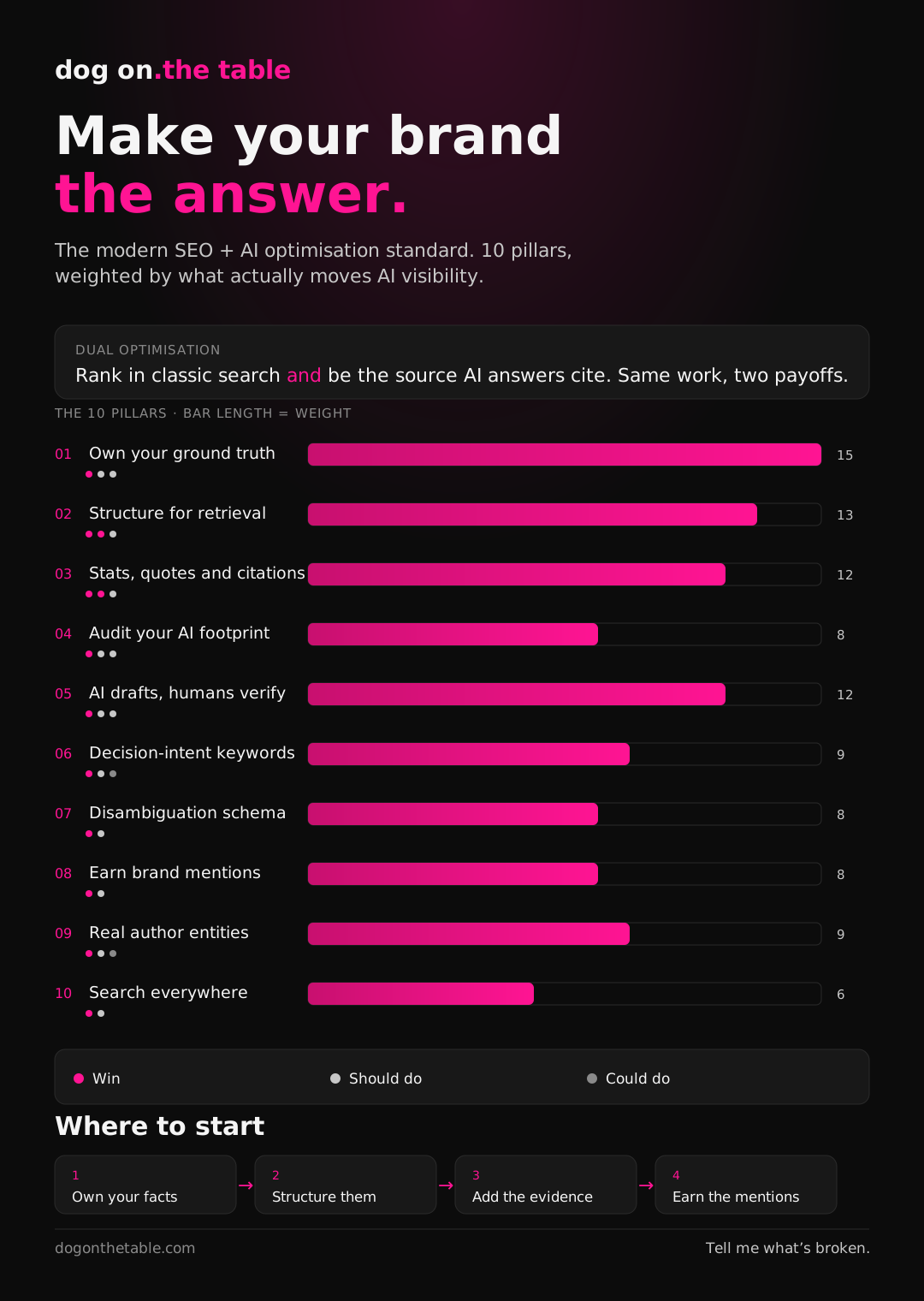
A visual summary of the framework.
Download the poster (SVG)Want help choosing where to start?
You don't have to work through every check at once. If you'd like help understanding a finding or choosing the next steps, we can look at your site together.